
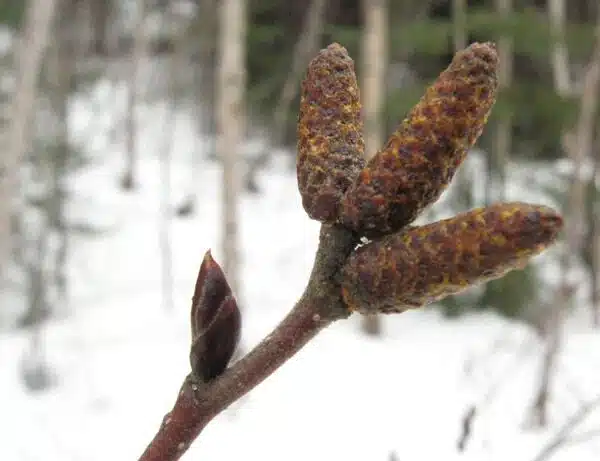
Americain Green Alder
Latin name : Alnus alnobetula subsp. crispa
French name : Aulne Crispé
English name : Green Alder
Botanical Family Name Betulaceae
Origin : Quebec, Canada
Harvest time : Autumn
Distilled Parts : Male catkins
Organoleptic Characteristics : Delicate flavour between rose and sweet almond
Components : Currently under analysis
Origin
Americain Green Alder, a subspecies of alder, is a native shrub found in northeastern North America and Greenland. As a nitrogen-fixing plant, it plays an important ecological role and is commonly used to restore infertile soils and stabilize riverbanks. It thrives particularly well in moist or cool soils but can also grow in poorer conditions.
Whether in full sun or partial shade, Green Alder can reach a height of 2 to 3 metres and spread up to 1.5 metres. In winter, its male catkins stand upright at the tips of the branches, a distinguishing feature that differentiates it from Speckled Alder, whose catkins hang downward.
Male catkins are also traditionally used in the preparation of poivre des dunes (dune pepper).
History
Indigenous peoples made extensive use of the properties of Green Alder to treat various ailments. Inuit communities prepared poultices from the leaves to help heal wounds and injuries. The Tanana people, for example, used a decoction of the inner bark to relieve stomach discomfort. The wood was also traditionally used for smoking fish.
Green Alder was thus valued for a wide range of uses, with Indigenous knowledge allowing each part of the shrub to be used according to its specific properties.
Description
Americain Green Alder hydrosol contains between 0.02% and 0.05% essential oil and 99.95% to 99.98% pure water drawn from the underground esker aquifer of Chapais.
Its pH ranges between 4.5 and 5.5.
This product is obtained exclusively through steam distillation of Green Alder male catkins. It is not a mixture of water and essential oil, an important distinction to highlight.
Contra-indications
None